Tunisian students and graduates considering a bachelor's, master's or PhD at a Malaysian institution for the 2027 intake. Student visas go through Education Malaysia Global Services (EMGS), a body under the Ministry of Higher Education Malaysia that also welcomes students at the airport in its ISAC centre. Opporiva is free and never applies on your behalf.
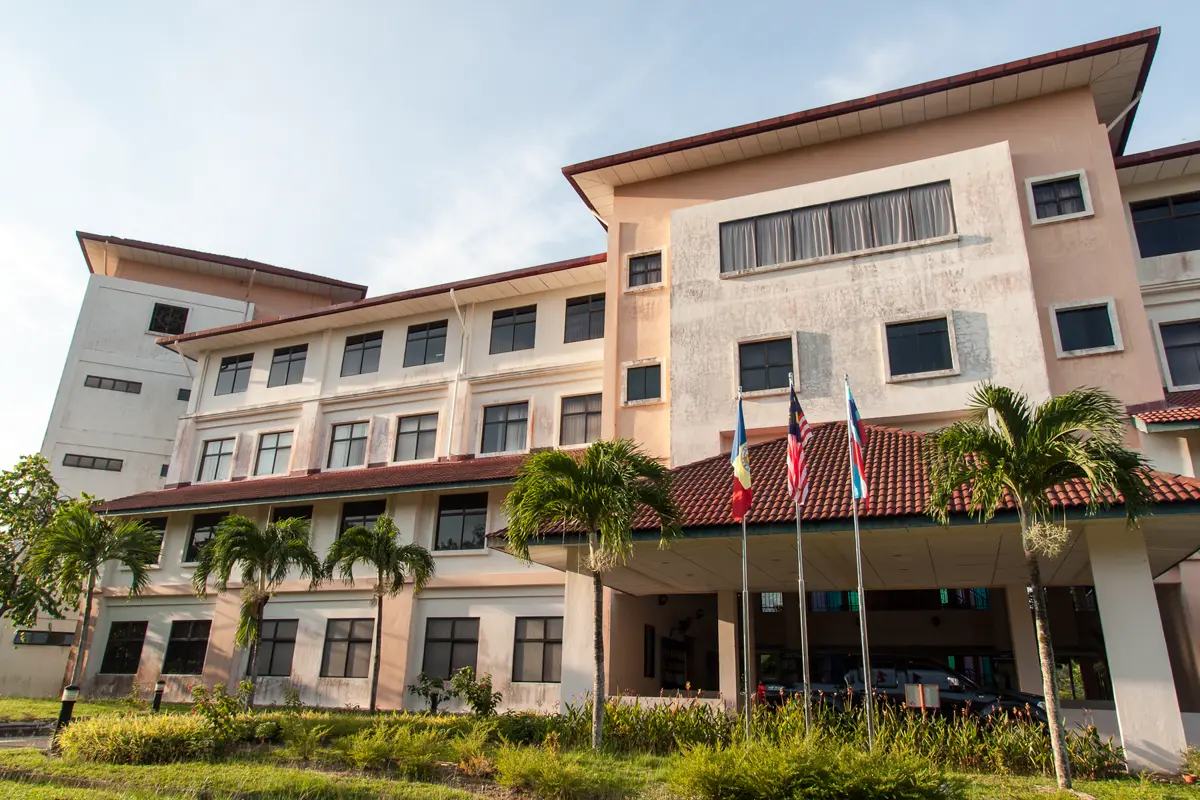
Universiti Malaysia Sabah campus (School of Social Sciences), Kota Kinabalu
Start by getting an offer letter from an institution; you cannot apply for the visa without it. For scholarships, the Malaysia International Scholarship (MIS) 2026 lists Tunisia among eligible countries. It funds full-time master's or PhD study at one of 24 listed universities, paying tuition directly to the university plus RM 1,500 a month (MIS 2026 terms). Applicants must be no older than 40 (master's) or 45 (PhD), hold a CGPA of at least 3.00 or equivalent, and have IELTS 6.0, a paper-based TOEFL score of 550 or a previous degree taught in English. The 2026/2027 round is closed; results can be checked from 8 October to 31 December 2026. Dates for the next round and each institution's tuition are to be confirmed.
Student Pass holders at public universities or private higher education institutions may work part-time during their studies, up to 20 hours a week, only at approved places (restaurants, petrol stations, mini markets, hotels, campus areas). The request goes to Immigration with a job offer, a support letter from the institution (with semester and holiday dates) and a passport copy; approval is at Immigration's discretion. The periods when work is allowed are to be confirmed with your institution. After a bachelor's degree or higher, a 12-month Graduate Pass is open only to citizens of 32 countries; Tunisia was not on that list on 23 October 2026. The Employment Pass for skilled jobs is a separate procedure, to be confirmed with Immigration.
EMGS lists Tunisia among countries whose citizens need a Single Entry Visa (SEV) before entering Malaysia. The study application is filed from abroad, online on the EMGS portal, by the student or the institution; after EMGS's academic screening, Immigration issues the eVAL electronic approval. The SEV is then applied for only on the official eVISA portal, malaysiavisa.imi.gov.my. For Tunisia, Malaysia's foreign ministry lists an honorary consul at the EAG Building, Avenue Beji Caid Essebsi, Les Berges du Lac, 1053 Tunis (tel. +216 71 967 785), under the Embassy of Malaysia in Algiers.
Before enrolling, check that the programme appears in the Malaysian Qualifications Register (MQR), the Malaysian Qualifications Agency's register of accredited programmes. It shows the institution's name and address, the title and level of the qualification, the accreditation's validity period, and the mode and length of study. Back home, apply for diploma equivalence with Tunisia's Ministry of Higher Education and Scientific Research.
For a first Student Pass application EMGS asks for: a passport photo on a white background (35 x 45 mm); a copy of your passport (data page and pages with visas), valid for at least 18 months, with validity 12 months beyond the course recommended for a pass covering the whole course; the offer letter; the health declaration form; your certificates and transcripts; and an English certificate. The institution also signs a personal bond for you and asks you to lodge the matching sum, refunded when you finish or withdraw if no immigration rule was broken; the amount is to be confirmed with the institution.
On 23 October 2026 the official EMGS fee calculator showed: RM 1,728 application fee for a first application at a public or private university (RM 864 for a short course), medical screening RM 250 to RM 350, Student Pass RM 60, eVAL RM 159, health insurance RM 498 to RM 644, i-Kad RM 50 or RM 60.60, and RM 20 for a Tunisian's multiple entry visa. An 8% service tax applies to processing fees from 1 March 2024. These amounts exclude tuition. The personal bond amount and any proof of funds are to be confirmed. EMGS puts on-campus housing at USD 50 to 150 a month (estimate checked on 23 October 2026).
Malay is the national language, but most university courses are taught in English, according to EMGS. For the Student Pass, EMGS accepts tests including MUET, IELTS, TOEFL iBT, PTE Academic and Cambridge English; without a certificate attached, processing may be delayed and the pass will not cover the full course. The minimum level depends on the programme: to be confirmed with the university.
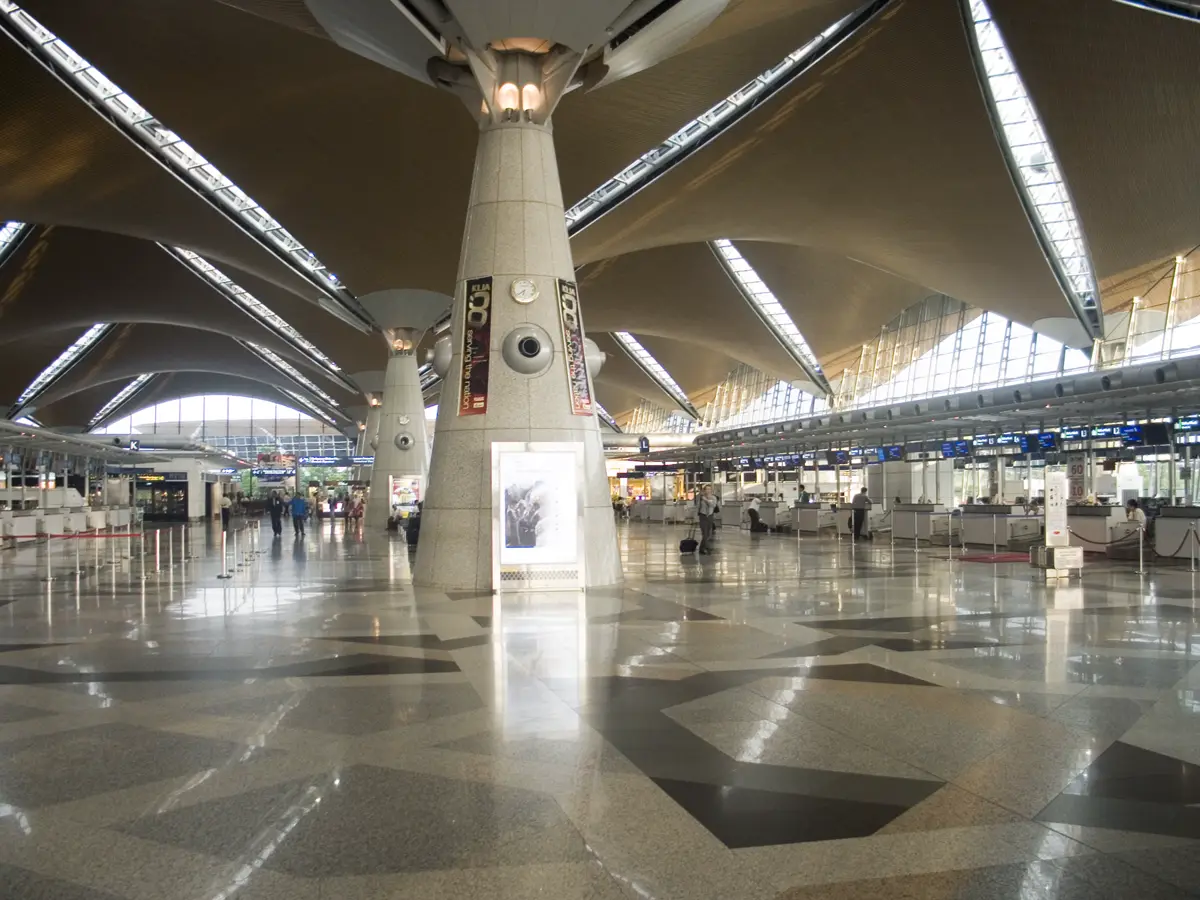
Main terminal, Kuala Lumpur International Airport (KLIA)
At the airport, EMGS's ISAC centre, open 24 hours, meets students before the immigration gate. Then complete your medical screening at an EMGS panel clinic within 7 working days of arrival; without it, EMGS cannot start the Student Pass endorsement in your passport.