Tunisians considering a Hungarian public university, especially with the Stipendium Hungaricum scholarship, or a fee-paying English-taught programme. Keep in mind from the start that admission and residence are separate: an offer or a scholarship does not replace the immigration document list. Opporiva is free and never applies on your behalf.
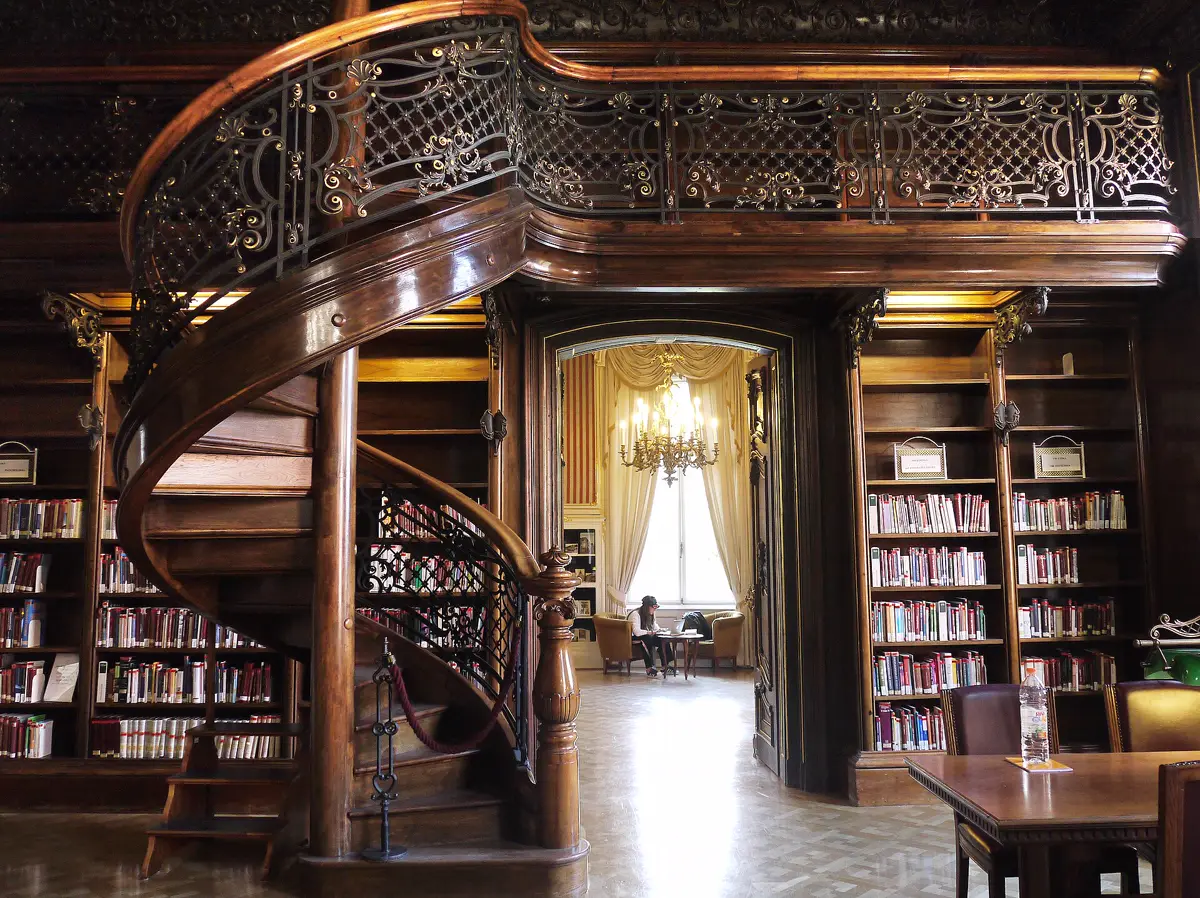
Reading room of the Metropolitan Ervin Szabó Library, Budapest
Tunisian eligibility confirmed: for 2026-2027, Tunisia's Ministry of Higher Education announced 250 Stipendium Hungaricum scholarships for Tunisian students at public universities (35 bachelor's, 15 one-tier master's, 130 master's, 70 PhD). Benefits announced for 2026-2027: tuition exemption, a monthly allowance of HUF 43,700 (bachelor's, one-tier master's, master's) or HUF 140,000 then HUF 180,000 (PhD), a dormitory place or a HUF 40,000 contribution to housing costs (frequency to be confirmed), and health insurance. You apply online on the programme site, and the ministry must then approve your file. Dates and quotas for the 2027-2028 call are to be confirmed: the Stipendium Hungaricum site was under maintenance on 23 October 2026. For fee-paying programmes, tuition is to be confirmed with each university.
With a residence permit for study, you may work up to 30 hours a week during your study period, and full-time for up to 90 days a year outside it. Hungary also issues other permits (employment, training); their conditions for Tunisian nationals are to be confirmed on the OIF website before you start.
You apply for the study residence permit at the Hungarian mission in your country of nationality or residence: for Tunisia, the Embassy of Hungary, 12 Rue Achtart, Nord-Hilton, 1082 Tunis. No separate visa application is needed: approval of the permit also approves a single-entry D visa (stay of up to 30 days, valid for 3 months). If you do not enter Hungary within 3 months, the approved permit lapses. A decision is normally due within 60 days of filing. Whether an external provider operates in Tunis, and the procedural fees, are to be confirmed with the embassy.
The Hungarian institution decides on your admission, and its admission certificate is part of the residence file. For other purposes (employment, a regulated profession, a PhD), ask the Hungarian ENIC-NARIC centre at the Educational Authority (Oktatási Hivatal): the procedures are to be confirmed, as its website could not be reached on 23 October 2026.
The OIF lists, among others: the signed form and annex, a photo, a valid passport, an admission certificate, proof of language level, proof of tuition payment (or a scholarship certificate), proof of means (bank certificate, notarised family support declaration with proof of the supporter's income, income documents or a scholarship certificate), a real address in Hungary and health cover. For Stipendium Hungaricum 2026-2027, the Tunisian ministry notice also asked for a motivation letter of at least one page, in the programme language or in Hungarian. Translation and legalisation requirements are to be confirmed with the university and the embassy.
As of 23 October 2026, the OIF factsheet does not set a minimum amount of means: the expected amount is to be confirmed with the embassy. It accepts several kinds of proof, including a scholarship certificate. As a reference point, the 2026-2027 Stipendium Hungaricum allowance is HUF 43,700 a month at bachelor's and master's level: a contribution to costs, not a full budget. Residence permit fees are published on a separate OIF page and are to be confirmed.
The official language is Hungarian, but some programmes are also taught in English or French. For Stipendium Hungaricum 2026-2027, Tunisia's ministry required bachelor's and one-tier master's applicants to have a baccalauréat average of at least 14 and at least 14 in the language of study (English or French), and the host university sets its own language prerequisites. For a Hungarian-taught course, a preparatory language year covered by the scholarship is possible.
The residence permit is sent by post to your institution's address. It is valid for at least one year (or the course length if shorter) and at most three years. To extend it, apply on the Enter Hungary platform between 90 and 30 days before expiry, with proof of academic progress. Changing institution also requires an application on Enter Hungary.
RESCO Consortium · Hungary, Spain, Portugal, France
Scholarship
Deadline: 19 May 2026Closed
Frequently asked questions
Are Tunisians eligible for Stipendium Hungaricum?
Yes. For 2026-2027, Tunisia's Ministry of Higher Education published an offer of 250 scholarships for Tunisian students. The 2027-2028 timeline is to be confirmed once published.
Where do I apply for a study residence permit from Tunisia?
At the Embassy of Hungary in Tunis (12 Rue Achtart, Nord-Hilton). There is no separate visa application: permit approval lets you obtain a D visa.
Can I work while studying in Hungary?
Yes, up to 30 hours a week during your study period, and full-time for up to 90 days a year outside it, according to the OIF.
How much money must I prove for the permit?
The OIF factsheet sets no minimum; the expected amount is to be confirmed with the embassy. A scholarship certificate is accepted as proof.